
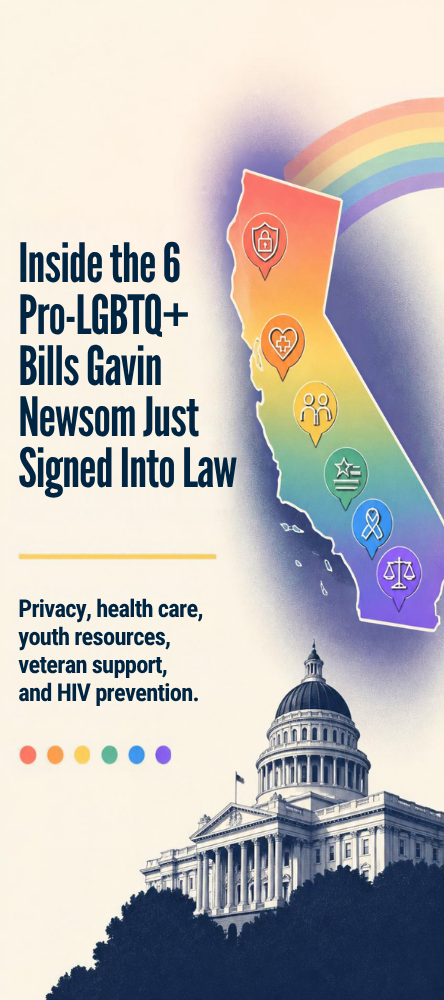
Governor Gavin Newsom signed a six-bill legislative package on September 26, 2026, aimed at fortifying civil rights, healthcare privacy, and institutional support for LGBTQ+ Californians. Framed explicitly as a defense against federal rollbacks and investigations, the new laws target practical vulnerabilities, from shielding transgender patients’ medical records and supporting discharged transgender servicemembers to removing insurance barriers for long-acting HIV prevention.
“The Trump administration has launched an all-out assault on the LGBTQ community, using medical records to target U.S. servicemembers and civilians alike, hurting countless people and betraying hard-won trust. California will not stand for it,” Gov. Gavin Newsom
Sponsored by Equality California and state legislative leaders, the package focuses on concrete legal and administrative protections that take effect across healthcare, military affairs, data privacy, and higher education.
| Bill | Author | Core Focus | What It Actually Does |
| AB 1775 | Asm. Chris Ward (D-San Diego) | Transgender Veterans | Connects servicemembers discharged under federal transgender military bans with state housing, employment, transition-to-civilian-life services, and expedited professional licensing. |
| AB 1930 | Asm. Rick Chavez Zbur (D-Los Angeles) | Healthcare Privacy | Tightens rules around out-of-state and federal subpoenas seeking gender-affirming or reproductive healthcare records, requiring providers and entities to notify the California Attorney General. |
| SB 934 | Sen. Scott Wiener (D-San Francisco) | Conversion Therapy | Adapts California’s restrictions on sexual-orientation and gender-identity change efforts in response to recent federal court rulings, expanding legal recourse and extending the statute of limitations for survivors. |
| SB 1023 | Sen. John Laird (D-Santa Cruz) | Injectable PrEP & PEP | Removes insurance reimbursement bottlenecks by requiring health plans to cover long-acting injectable PrEP and PEP across standard medical and pharmacy benefits. |
| SB 1114 | Sen. Christopher Cabaldon (D-Yolo) | LGBTQ+ Data Shield | Strictly limits when and how state agencies can disclose demographic data regarding sexual orientation, gender identity, or intersex status. |
| SB 1328 | Sen. Sabrina Cervantes (D-Riverside) | Higher Education | Expands the Equity in Higher Education Act by requiring designated LGBTQ+ campus liaisons and support resources at regional and satellite college campuses. |
Headline political battles often overshadow the day-to-day administrative hurdles that affect LGBTQ+ lives. Three areas of this legislative package address immediate, practical friction points:
- Closing the Data and Subpoena Gap (AB 1930 & SB 1114): As federal agencies and out-of-state prosecutors increasingly seek medical and demographic records related to gender-affirming care, California is building legal firewalls. Requiring notification to the Attorney General under AB 1930 prevents quiet compliance with hostile out-of-state discovery requests, while SB 1114 ensures that voluntary self-identification on state forms cannot be weaponized if federal agencies demand state databases.
- Removing Friction for HIV Prevention (SB 1023): Long-acting injectable PrEP is one of the most effective tools available to end new HIV transmissions, yet outdated insurance billing rules between medical and pharmacy benefits have kept clinics and pharmacies from stocking it. By fixing reimbursement pathways, paired with $66 million in the 2026-27 state budget to support medication access, SB 1023 makes injectable prevention far easier to access at local community clinics.
- Reaching Underserved Students and Veterans (AB 1775 & SB 1328): Extending campus LGBTQ+ liaisons to satellite campuses (SB 1328) directly benefits students in regions outside major coastal metro areas who rely on regional college centers. Similarly, AB 1775 ensures that while California cannot overturn Pentagon policy, transgender servicemembers forced out of the military will not lose access to state veteran benefits or career licensing when they return home.
While civil rights organizations welcomed the six-bill package, the signing came just days after a high-profile point of friction between the Governor’s office and LGBTQ+ advocates.
Earlier in the week, Newsom vetoed AB 2164, a bill that would have prohibited the governor from honoring out-of-state extradition warrants for healthcare providers or patients involved in legally protected gender-affirming or reproductive care in California. In his veto message, Newsom stated that he agreed with the bill’s underlying principles, but argued that extradition is an exclusively executive function and declined to legally bind the authority of future governors.
For community advocates, the contrast underscores an important reality as Newsom wraps up his final legislative session as governor: California’s statutory protections remain the strongest in the country, but defending healthcare providers, transgender youth, and families requires ongoing vigilance and sustained community pressure.
