
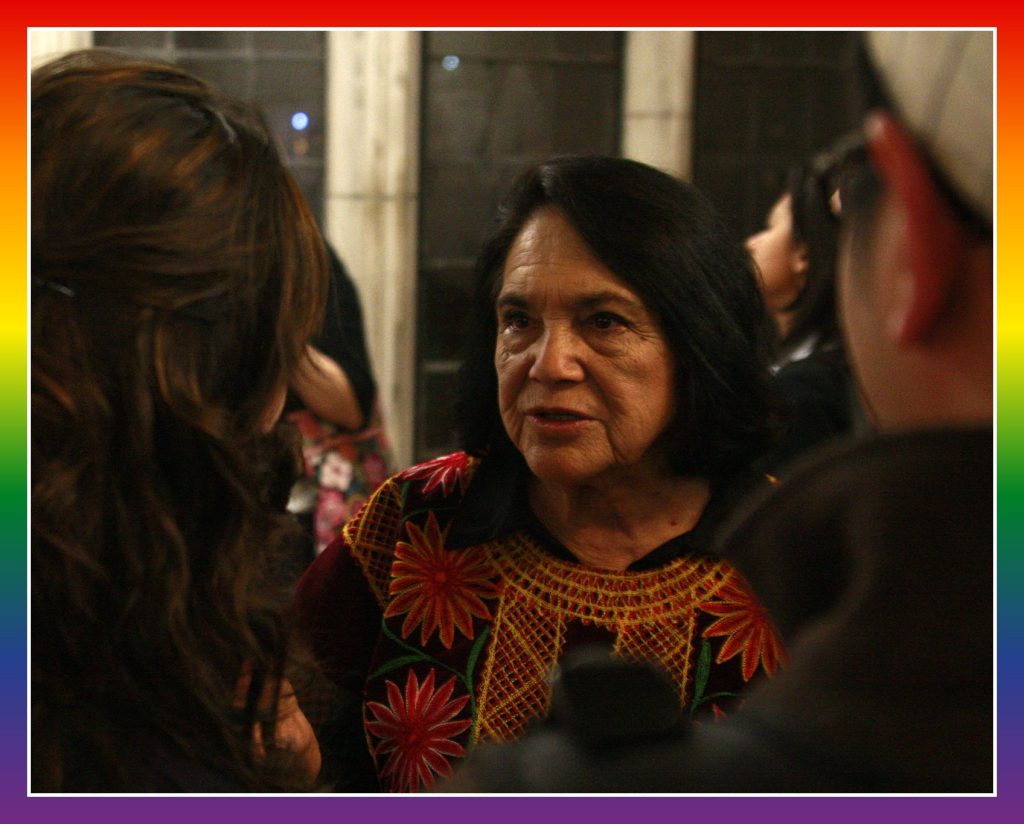
Dolores Huerta, the labor leader who co-founded the United Farm Workers and gave the world the rallying cry “Sí, se puede,” died Wednesday, October 28, 2026, at her home in Bakersfield. She was 96.
Her family announced her death in a statement, saying, “We are deeply saddened to announce that our beloved mother, Dolores Huerta, has passed away today at the age of 96.” A family spokesman said she died of cancer. Her family asked for privacy as they grieve and said plans to recognize and celebrate her life and legacy will follow.
For LGBTQ+ people in the Central Valley and beyond, Huerta was far more than a figure from the history books. She spent decades showing up — in picket lines, in legislative fights, in Pride crowds, and right here in Fresno — for the idea that no one’s rights are negotiable.
From the classroom to the fields
Huerta was born Dolores Clara Fernández on April 10, 1930, in Dawson, New Mexico, and raised in Stockton, California, by her mother, Alicia, who ran a small hotel and restaurant and often fed farmworker families in need. She trained as a teacher, but left the classroom after seeing her students — the children of farmworkers — come to school hungry and without shoes. She believed she could do more by organizing their parents than by teaching their hungry children.
In 1955 she founded the Stockton chapter of the Community Service Organization, leading voter registration drives and fighting for economic stability for Latino families. In 1962, alongside César Chávez and Gilbert Padilla, she co-founded the National Farm Workers Association, the organization that became the United Farm Workers. She served as the union’s vice president for nearly four decades.
Huerta helped lead the Delano grape strike of 1965 alongside Filipino leader Larry Itliong, ran the union’s nationwide boycott campaigns from the East Coast, and negotiated with grape companies to end the strike. The movement’s campaigns helped win the first farmworker union contracts in American history and helped pass California’s landmark Agricultural Labor Relations Act of 1975, which established collective bargaining rights for farmworkers.
She coined — or, as some accounts have it, popularized — the slogan “Sí, se puede.” The story goes that in 1972, in Arizona, when someone told her that what the union had won in California could not be done there, she shot back: “Sí, se puede.” Yes, it can be done. The room took up the chant, and it never stopped.
The work cost her. She was arrested more than 20 times for nonviolent protest, and in 1988, a San Francisco police officer beat her so severely at a union demonstration that she suffered broken ribs and had her spleen removed. She kept organizing. In 2012, President Barack Obama awarded her the Presidential Medal of Freedom. In 2002 she founded the Dolores Huerta Foundation, based in Bakersfield, which continues her work in grassroots organizing and civic engagement across the Central Valley. California marks April 10 as Dolores Huerta Day.
An LGBTQ+ ally, in word and in deed
Huerta’s support for LGBTQ+ rights was not a late addition to her politics — it ran through her whole career.
In the 1970s, the United Farm Workers publicly endorsed adding “sexual orientation” as a protected characteristic under California civil law, and Huerta herself spoke against discrimination based on sexual orientation at a legislative hearing in that era. She often traced her conviction to the early farmworker movement itself, where she worked alongside gay men in the packing sheds who were, in her words, strong activists — and to a simple belief she repeated all her life: that any kind of discrimination is wrong.
In 2005, she campaigned alongside California Assemblyman Mark Leno for Assembly Bill 19, which would have legalized same-sex marriage in California. The bill passed the Assembly but was vetoed by Governor Arnold Schwarzenegger. Speaking in favor of marriage equality the following year, she put it plainly: if two women get married, does that affect your paycheck? Marriage, she said, is a matter of privacy and constitutional rights — quoting Benito Juárez, “respecting other people’s rights is peace.”
She carried that message into rooms where it was not always welcome. In interviews with the Human Rights Campaign, she urged leaders across the Latino community to take a public stand, saying leaders cannot represent their constituents if they do not represent and educate all of their community on LGBTQ equality. In 2013, she appeared in a public education video for Familia es Familia, a national campaign building support for LGBTQ members of the Latino community. And her definition of a feminist, as she gave it in the documentary “Dolores,” explicitly included someone “who supports LGBT rights.”
She brought that advocacy home to the Valley. She spoke at a Pride celebration in Fresno in 2021, advocating for LGBTQ rights and warning that discriminatory rhetoric against LGBTQ people “leads to violence.” In 2024, her foundation endorsed California’s Proposition 3, which removed language defining marriage as between “a man and a woman” from the state constitution and affirmed marriage as a fundamental right; voters passed it with 63 percent of the vote.
A Fresno connection
Huerta’s ties to Fresno were real and recent. In 2009, she spoke at Camp Courage in Fresno, the grassroots training weekend that helped galvanize Central Valley LGBTQ organizing after Proposition 8 — an event this site covered at the time, including an interview with her. And as recently as April 2025, at age 95, she drew more than 650 people to Fresno City College for an afternoon on social justice, nonviolent protest, and community action.
Her foundation’s work also reaches Fresno’s young people: the Dolores Huerta Foundation’s LYFE program has been part of the youth programming PFLAG Fresno has planned for its support meetings, connecting Valley youth to leadership and civic life.
Her final year
Her final year also carried a painful disclosure. Earlier in 2026, Huerta told The New York Times that Chávez had sexually abused her in the 1960s — a revelation that shook the movement she helped build and prompted reckonings across California. We note it here because she chose to speak it, in her own voice, at 95, after keeping it private for six decades.
Sí, se puede
Huerta liked to say that the work belongs to everyone. Her slogan was never only about farmworkers, and it was never only about one movement. It was a claim that ordinary people, acting together, can change what seems unchangeable — in the fields, in the legislature, and in the streets.
That is the legacy she leaves Fresno, the Central Valley, and all of us: show up, stand with each other, and never accept that it can’t be done.
Sí, se puede.
From our own site:
Camp Courage in Fresno – Interview with Dolores Huerta (2009)
The Movement is Headed to Fresno, CA — Camp Courage, with Dolores Huerta (2009)
PFLAG Fresno: Still Doing the Work to Make It Better for LGBTQ+ People (2022)
More on her life:
USA Today: Dolores Huerta, United Farm Workers co-founder and labor pioneer, dies at 96
Photo: Dolores Huerta in 2009. Photo by Eric Guo, licensed CC BY via Wikimedia Commons; rainbow frame added.
